

When Hydrants Run Dry: What The 2025 Los Angeles Palisades Fire Revealed About Fire Water Supply Infrastructure
Leave a message
The catastrophic Palisades Fire exposed a critical vulnerability in urban firefighting systems - and sparked a global conversation about how fire hydrant networks are designed, maintained, and stress-tested.
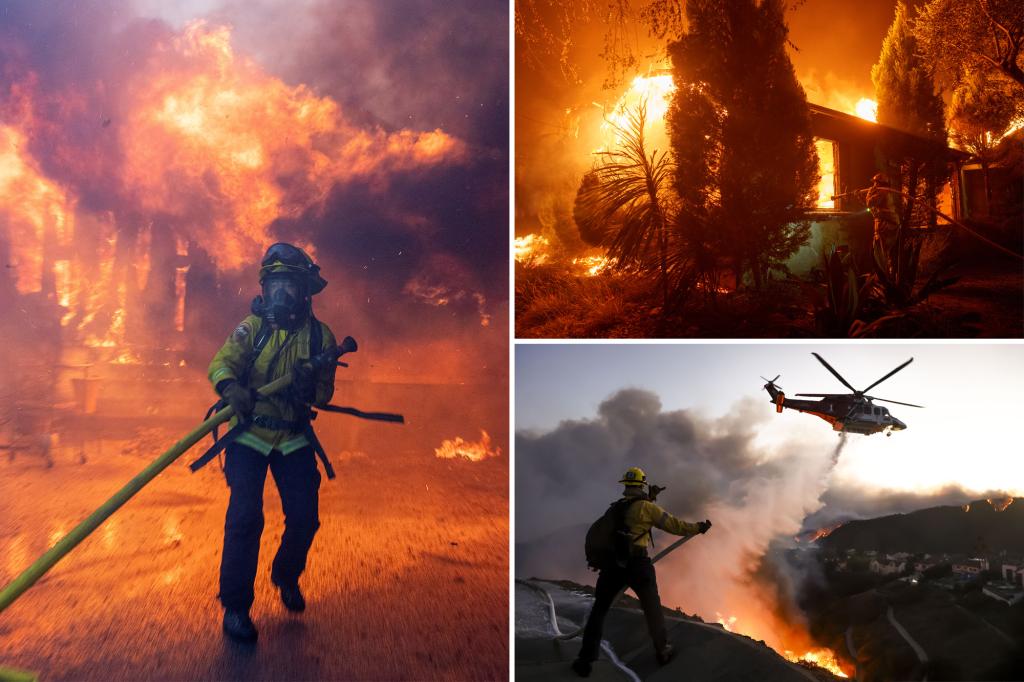
On the morning of January 7, 2025, a fast-moving wildfire ignited in the Pacific Palisades neighborhood of Los Angeles. Within hours, it had grown into one of the most destructive urban fire events in California history. Together with the concurrent Eaton Fire, the blazes destroyed thousands of structures, killed at least 31 people, and caused tens of billions of dollars in damage.
But alongside the images of burning hillsides, a different story emerged - one that sent shockwaves through the global fire protection industry: firefighters on the ground were losing water pressure. And then, in some locations, losing water entirely.
What Happened: A Timeline of Pressure Loss
By 5 p.m. on January 7 - less than seven hours after the Palisades Fire ignited - the first of three one-million-gallon elevated storage tanks supplying the neighborhood's hydrant network had run dry. The second depleted before 9 p.m. By 3 a.m. on January 8, all three tanks had reached empty.
The result: approximately 20% of fire hydrants in the affected high-elevation areas were delivering no water at all. Firefighters who had stretched hose lines to structures found pressure failing mid-operation.
"We had tremendous demand on our systems in the Palisades," said Janisse Quiñones, CEO of the Los Angeles Department of Water and Power (LADWP), at an emergency press conference. "We pushed the system to the extreme. Four times the normal demand was seen for 15 hours straight, which lowered our water pressure."
The physical mechanics were straightforward but devastating in practice. The storage tanks are designed to supply hydrant pressure through gravity and are replenished continuously by pumps drawing from main trunk lines. Under normal conditions, this works seamlessly. Under wildfire conditions - with dozens of engine companies simultaneously flowing water, burning structures rupturing supply pipes and bleeding additional pressure, and demand four times above design capacity - the replenishment pumps simply could not keep pace with consumption.
When the tanks depleted, pressure at high-elevation hydrants dropped below functional levels, in some cases to zero.
The Reservoir Question: A Complicated Answer
Public attention quickly focused on the Santa Ynez Reservoir - a 117-million-gallon facility in upper Pacific Palisades that had been drained in February 2024 for essential repairs to its cover, a requirement under federal safe drinking water regulations. With the reservoir still offline during the fire, many observers concluded that its absence was directly responsible for the hydrant failures.
The reality, as a subsequent 10-month investigation by California state officials concluded, was more complex. The state report determined that even if the Santa Ynez Reservoir had been full and operational, "the hydrants could not have maintained pressure." The fundamental constraint was not total water volume - the broader Los Angeles water supply was described as "robust" at the time of the fire - but rather the rate at which water could physically move through the distribution network to high-elevation areas under unprecedented simultaneous demand.
"The hydrants would have run dry anywhere in the world with a fire event like this in the topography where this occurred," said Greg Pierce, director of the UCLA Human Right to Water Lab. State Fire Marshal Daniel Berlant echoed this assessment, noting that "a firefight at this size, such an urban conflagration, any system is going to have its challenges in maintaining water pressure."
This does not absolve planning failures. The LAFD's own after-action report acknowledged that when hydrant pressure began to fail, firefighters faced confusion and costly delays in securing water tender trucks as alternatives. Pre-incident coordination between the fire department and LADWP - which could have pre-positioned tender resources given the extreme wind forecast - had not taken place. "They had ample opportunity to have these discussions and implement their water tender strategy," said Rick Crawford, a former LAFD battalion chief. "None of this was done."
A Pattern, Not an Anomaly
Perhaps the most important finding to emerge from post-incident analysis was that this type of hydrant failure is not unique to Los Angeles. Research published in 2025 confirmed that hydrant pressure failure under mass wildfire conditions follows a pattern seen repeatedly in other urban fire disasters.
The 2023 Lahaina wildfire in Hawaii - which killed 101 people and largely destroyed the historic town - involved similar dynamics: extreme simultaneous demand overwhelming a distribution system not engineered for that load. Post-incident analysis of Lahaina identified inadequate system capacity, aging infrastructure, and the absence of dedicated firefighting water reserves separate from the potable supply as compounding factors.
This points to a structural issue that the Palisades Fire brought into sharp relief: municipal water systems are not designed for wildfire suppression. They are designed for domestic consumption, commercial use, and ordinary building fires - scenarios where demand is localized and manageable. A wildfire attacking dozens of structures simultaneously on a steep hillside in 80 mph winds is an entirely different hydraulic event.
Key Technical Lessons for Fire Protection Professionals
The Palisades Fire and the body of analysis it generated carry direct implications for fire protection engineers, infrastructure planners, and procurement professionals worldwide.
1. Hydrant network design must account for worst-case simultaneous demand
Standard hydrant spacing and main sizing calculations are typically based on flows required for a single large structure fire. In wildland-urban interface (WUI) zones, the design basis must be fundamentally re-examined to account for multiple simultaneous structure fires. This requires larger-diameter supply mains, higher-capacity storage tanks sized for sustained firefighting duration, and - in high-risk topographic situations - dedicated firefighting water reserves physically separate from the potable supply system.
2. Elevation is a critical variable
The Palisades failures were concentrated in high-elevation areas precisely because gravity-fed systems lose residual pressure fastest when elevated tanks deplete. Systems serving hilly or mountainous terrain require enhanced pumping redundancy, additional intermediate storage, or dedicated high-zone firefighting reservoirs with independent supply circuits.
3. Hydrant infrastructure must be treated as fire protection infrastructure - not just water utility infrastructure
One consistent theme in post-incident analysis of both Lahaina and Los Angeles is that fire hydrant systems are managed primarily as components of the potable water distribution network, with firefighting performance as a secondary consideration. Industry experts increasingly argue that critical WUI communities require dedicated firefighting water systems with independent storage, supply, and management - a model that some industrial facilities and airports already use effectively.
4. Maintenance and testing schedules matter operationally, not just for compliance
Hydrants that have not been flow-tested recently provide unreliable data for pre-incident planning. Regular flow testing - measuring actual available flow and residual pressure at each hydrant under various demand conditions - gives fire departments accurate information to plan response and identify deficiencies before an incident. Private hydrants on industrial and commercial sites must be held to the same testing discipline as municipal systems.
5. Pre-incident coordination between fire departments and water utilities is a force multiplier
The LAFD after-action report identified the absence of pre-incident briefings with LADWP as a significant operational gap. When fire departments know that water supply will be under stress - as was clearly foreseeable from the wind forecast in this case - they can pre-position mobile water tender resources, identify alternative supply points, and brief company officers before pressure issues arise. This coordination costs nothing and can be decisive.

What This Means for Infrastructure Investment
The Palisades Fire has accelerated policy discussions that had been ongoing for years in fire-prone regions. Several actionable directions are gaining traction:
Dedicated firefighting water infrastructure in WUI zones, physically separated from potable systems and sized for mass casualty wildfire events rather than standard building fires
Underground cistern networks as supplemental supply, which several European cities have long maintained as a resilience layer independent of mains pressure
Smart hydrant monitoring systems capable of reporting real-time pressure and flow data to incident command during active firefighting, enabling dynamic resource reallocation
Mandatory flow testing intervals with data centralized and accessible to fire departments during response planning
For fire protection equipment suppliers and system designers, the moment calls for engagement - offering infrastructure planners not just compliant hydrant products, but technical guidance on system integration, pressure zone design, and the full hardware ecosystem that supports reliable water supply under extreme demand.
A Broader Reflection
The 2025 Los Angeles fires did not reveal a uniquely American problem or a uniquely Californian failure. They revealed a global infrastructure gap: communities in wildfire-prone areas are increasingly building into terrain where the water systems beneath their streets were never engineered for the fires above them.
Fire hydrants are among the most visible and trusted symbols of public fire protection. The images of firefighters connecting to dry hydrants in Pacific Palisades delivered a clear message: visible infrastructure is not the same as reliable infrastructure. Flow rate, pressure sustainability under peak demand, and the supply chain behind every hydrant - storage capacity, pump redundancy, main sizing, elevation differentials - are what determine whether a hydrant works when it matters most.
For the fire protection industry, this is both a challenge and a responsibility. The engineering knowledge to build more resilient water supply systems exists. What the Palisades Fire underscored is the urgency of applying it.
Sources: Los Angeles Department of Water and Power post-incident briefings; California state investigation report (November 2025); LAFD After-Action Report; CalMatters, National Geographic, CNBC (January–December 2025); UCLA Human Right to Water Lab; NFPA 1 Fire Flow Requirements (2024 edition); FEMA Water Supply Systems and Evaluation Methods.


