

How to Measure Butterfly Valve Size (Complete Industrial Guide)
Leave a message
Accurately measuring a butterfly valve is essential for ensuring proper installation, leak-free performance, and long service life. In systems such as fire protection, water supply, HVAC, and industrial pipelines, even small measurement errors can lead to serious issues like misalignment, pressure loss, or sealing failure.
This guide provides a detailed, step-by-step explanation of how to measure butterfly valve size correctly, along with practical engineering tips to help you avoid common mistakes.

1. Understanding Butterfly Valve Sizing Basics
Before measuring, it's important to understand that butterfly valve size is not just one single dimension. It is a combination of several key parameters:
Nominal diameter (DN/NPS)
Face-to-face length
Flange drilling standard
Disc and seat dimensions
Stem size
Pressure rating
👉 All these factors must match your pipeline system to ensure proper operation.
2. Measure the Nominal Diameter (DN / NPS)
The nominal diameter is the most critical parameter and defines the valve size.
DN (Diameter Nominal): Metric unit (mm)
NPS (Nominal Pipe Size): Inch-based system
How to Measure:
Measure the inner diameter (ID) of the pipe connected to the valve
Alternatively, measure the valve seat inner diameter
Example:
DN50 ≈ 2 inches
DN100 ≈ 4 inches
DN200 ≈ 8 inches
💡 Engineering Insight:
Butterfly valves are designed to match standard pipe sizes. If the valve DN does not match the pipe DN, it will affect flow rate and may cause turbulence or leakage.
3. Measure Face-to-Face Length (Installation Dimension)
The face-to-face length refers to the distance between the two sealing faces of the valve.
Why It Matters:
Ensures the valve fits into existing piping systems
Critical for replacement projects
Prevents pipeline stress or misalignment
Standards:
API 609
EN 558
ISO 5752
💡 Practical Tip:
Even if two valves have the same DN, their face-to-face lengths may differ depending on design (wafer vs lug vs flanged).
4. Identify Flange Standard and Bolt Pattern
Butterfly valves are typically installed between flanges, so flange compatibility is crucial.
Key Measurements:
Flange outer diameter (OD)
Pitch circle diameter (PCD / BCD)
Number of bolt holes
Bolt hole diameter
Common Standards:
ANSI / ASME (Class 150 / 300)
DIN (PN10 / PN16 / PN25)
JIS
💡 Important:
Different flange standards are not interchangeable, even if the nominal size is the same.
5. Measure Valve Disc and Seat Dimensions
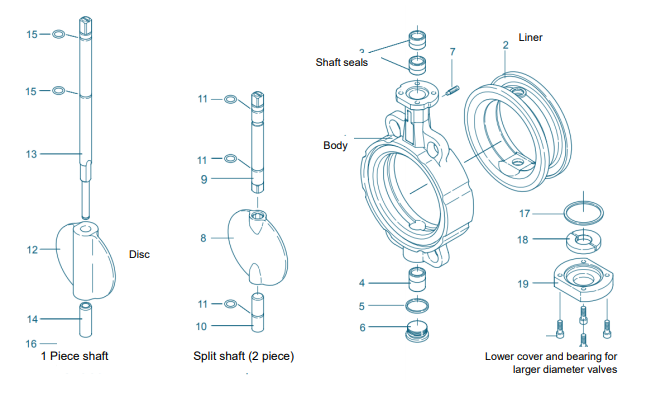
The disc (butterfly plate) and seat determine sealing performance.
What to Check:
Disc outer diameter
Seat inner diameter
Seat material (EPDM, NBR, PTFE, etc.)
Why It Matters:
Ensures tight shut-off
Prevents internal leakage
Maintains flow efficiency
💡 Maintenance Tip:
When replacing worn parts, always measure both disc and seat carefully to ensure compatibility.
6. Measure Stem (Shaft) and Actuator Connection
The stem connects the valve to the actuator or manual handle.
Key Dimensions:
Stem diameter
Stem length/height
Keyway or square drive size
Importance:
Ensures compatibility with:
Gear operators
Electric actuators
Pneumatic actuators
💡 Tip:
Incorrect stem sizing may prevent actuator installation or cause operational failure.
7. Determine Valve Type and Structure
Butterfly valves are available in different configurations:
1. Wafer Type
Installed between two flanges
Lightweight and cost-effective
2. Lug Type
Threaded inserts for bolting
Allows one-side disassembly
3. Flanged Type
Full flange connection
More stable for large pipelines
👉 Each type has slightly different dimensional requirements, especially for installation and bolt alignment.
8. Verify Pressure Rating and Material
Sizing is not complete without checking pressure rating and material compatibility.
Pressure Ratings:
PN system (PN10, PN16, PN25)
ANSI Class (Class 150, 300)
Material Considerations:
Body: Cast iron, ductile iron, stainless steel
Disc: Stainless steel, bronze
Seat: Rubber or PTFE
💡 Application Insight:
For fire protection systems, valves must withstand high pressure and be corrosion-resistant.
9. Consider Real Application Conditions
In real-world projects, measurement must align with working conditions:
Water supply systems
Fire protection systems
Foam systems
Chemical pipelines
For example, butterfly valves are widely used in:
Fire sprinkler systems
Fire hydrant networks
Fire water monitor systems
👉 Learn more about related fire protection solutions
10. Step-by-Step Measurement Summary
Here is a quick checklist:
Measure pipe inner diameter → determine DN/NPS
Measure face-to-face length
Check flange standard and bolt pattern
Measure disc and seat size
Measure stem dimensions
Identify valve type
Confirm pressure rating
11. Common Mistakes to Avoid
❌ Measuring outer diameter instead of inner diameter
❌ Ignoring flange drilling standards
❌ Assuming all DN sizes are identical across standards
❌ Forgetting actuator compatibility
❌ Overlooking pressure and temperature limits
12. Expert Tips for Buyers and Engineers
Always request technical drawings from suppliers
Compare old valve specifications before replacement
Keep a record of system standards (ANSI, DIN, etc.)
When in doubt, consult a professional manufacturer
Conclusion
Measuring a butterfly valve involves more than checking its diameter-it requires a full understanding of dimensional standards, installation requirements, and application conditions. By carefully evaluating all parameters, you can ensure proper fit, reliable sealing, and efficient system performance.
Need Professional Support?
If you need help selecting the right butterfly valve or matching it with your fire protection system, feel free to reach out.
CA-FIRE – Professional Fire Protection Equipment Supplier
🌐 Website: https://www.cafire-119.com/
📧 Email: miki@ca-fire.com
📱 WhatsApp: +86 18160950625


