


Horizontal Foam Bladder Tank Carbon Steel Shell
Horizontal foam bladder tank with internal rubber or PVC liner, designed for reliable foam concentrate storage and proportioning. The flexible bladder separates water and foam liquid to ensure stable mixing performance. Widely used in oil depots, chemical plants, ports, warehouses, and other high-risk fire protection systems.
Description
Ca-Fire Protection Co.,Ltd is one of the most credible manufacturers and suppliers of horizontal foam bladder tank carbon steel shell in China. Welcome to wholesale custom made fire equipment products at competitive price from our factory. Contact us for more cheap products.
Products Description
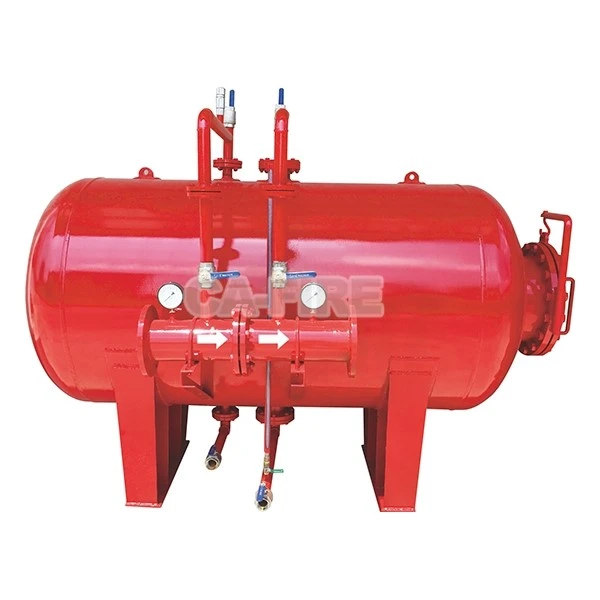
Horizontal Foam
Bladder Tank
Carbon Steel Shell
A pressure vessel built to store foam concentrate and feed a balanced-pressure proportioning system without pumps or external power. The carbon steel shell takes the structural and pressure load, while an internal bladder - available in rubber or PVC - physically separates concentrate from the water that drives it out. Capacity is built to order around your tank room footprint and design flow rate.
What it is
A storage vessel that doses itself
No pump, no power, no calibration drift
A bladder tank is essentially a foam concentrate reservoir that uses incoming water pressure, rather than an electric pump, to push concentrate out toward the proportioner. Water enters the shell side and squeezes the bladder from the outside; as it collapses, concentrate is forced through the outlet at a rate matched to the water flow. The result is a proportioning system with very few moving parts - which matters in a tank room that may sit untouched between annual inspections.
The horizontal layout is chosen for installations where headroom is limited but floor footprint is available - pump houses, foam stations alongside tank farms, or retrofits into an existing equipment skid. Capacity, shell diameter, and nozzle layout are configured per project rather than sold off a fixed size chart.
How the shell and bladder divide the work
The shell carries the full design pressure of the water system and the static load of a tank that may hold several thousand litres of liquid. Carbon steel plate, rolled and welded to pressure-vessel practice, gives the wall thickness and weld integrity needed for that duty at a cost that keeps larger capacities economically viable - which matters because foam tanks scale up quickly on real projects.
The bladder never sees structural load; its only job is to keep two liquids apart without contaminating either one, while flexing through thousands of fill-and-discharge cycles over the tank's service life. That is a chemical-compatibility and flexibility problem, not a strength problem - which is why the bladder is a separate material choice from the shell, sized and selected against the specific foam concentrate it will hold.

Bladder material
Rubber or PVC - matched to the concentrate

PVC bladder
A PVC bladder is lighter, generally lower in cost, and easier to fabricate into custom shapes for non-standard tank geometries. It performs well in temperature-controlled indoor tank rooms and is commonly paired with synthetic or fluorine-free foam concentrates that are compatible with PVC sheeting. It is less suited to environments with large temperature swings or prolonged sub-zero exposure.

Rubber bladder
A synthetic rubber bladder, typically EPDM or NBR-based depending on the concentrate, offers strong flex fatigue resistance and holds its elasticity across a wider temperature range. It tends to be the default choice for outdoor installations subject to seasonal temperature swings, and for AFFF or protein-based concentrates where long-term chemical exposure data on rubber compounds is well established.
Where it gets installed
Typical applications
Tank farm foam stations
Positioned beside fixed foam chambers and pump houses serving floating-roof or fixed-roof storage tanks, sized to deliver a full discharge cycle without relying on grid power for the proportioning step itself.
Aircraft hangars
Compact horizontal footprint suits equipment rooms with limited headroom, feeding low-level or high-level foam discharge systems sized for the hangar's covered floor area.
Chemical and industrial plants
Often specified alongside deluge or sprinkler systems protecting flammable-liquid process areas, where the bladder material is chosen to match the specific foam concentrate already standardized across the site.
FAQ
Q: What is a foam bladder tank used for?
A: It stores foam concentrate and uses water pressure to discharge and mix foam solution for fire suppression.
Q: What is the difference between rubber and PVC bladder?
A: Rubber bladder offers higher durability and flexibility, while PVC bladder is more economical but less resistant to low temperature and long-term wear.
Q: How does the bladder work?
A: The bladder separates foam concentrate from water; water pressure squeezes the bladder to ensure stable foam proportioning.
Q: What industries use this equipment?
A: It is widely used in oil depots, chemical plants, warehouses, ports, and aircraft hangars.
Q: Is maintenance required?
A: Yes. Regular inspection is needed to ensure no leakage, deformation, or aging of the bladder for reliable system performance.
Our address
NO.8, YUANFENG ROAD, MEIYUAN VILLAGE, KANGMEI TOWN, NANAN CITY, QUANZHOU CITY, FUJIAN CHINA

Hot Tags: horizontal foam bladder tank carbon steel shell, China horizontal foam bladder tank carbon steel shell manufacturers, suppliers, factory
Send Inquiry
You Might Also Like


