
K-Factor in Fire Sprinklers: What Does K5.6, K8.0 and K11.2 Mean?
Leave a message
Fire sprinklers are one of the most important components in an automatic fire protection system. When selecting the right sprinkler, engineers and contractors need to consider several factors, including temperature rating, response type, installation position, and K-factor.
The K-factor is a key parameter that determines the water discharge capacity of a sprinkler. Understanding the difference between K5.6, K8.0, and K11.2 sprinklers helps designers select the correct sprinkler for different fire hazards and building applications.
What Is K-Factor in Fire Sprinklers?
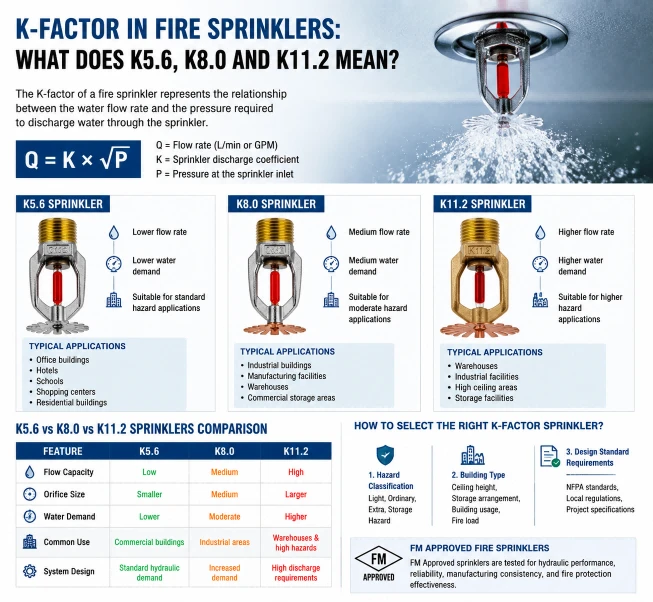
The K-factor of a fire sprinkler represents the relationship between the water flow rate and the pressure required to discharge water through the sprinkler.
Simply put:
A higher K-factor sprinkler can deliver more water at the same operating pressure.
The K-factor is calculated based on the formula:
Q = K × √P
Where:
Q = Flow rate (L/min or GPM)
K = Sprinkler discharge coefficient
P = Pressure at the sprinkler inlet
A sprinkler with a larger K-factor has a larger orifice opening, allowing more water to flow during fire suppression.
Why Is K-Factor Important?
Choosing the correct K-factor affects:
1. Fire Suppression Performance
A higher K-factor sprinkler provides a greater water discharge rate, which can improve fire control for higher-risk applications.
2. Hydraulic System Design
The K-factor directly influences:
Pipe sizing
Water demand calculation
Pump capacity
System pressure requirements
3. Application Suitability
Different buildings and fire hazards require different sprinkler discharge capacities.
For example:
Offices and commercial buildings usually use lower K-factor sprinklers.
Warehouses and high-piled storage areas often require larger K-factor sprinklers.
K5.6 Sprinkler: Standard Coverage Applications
K5.6 sprinklers are among the most commonly used standard sprinklers in commercial and residential fire protection systems.
Features:
Standard discharge capacity
Lower water demand
Suitable for normal hazard applications
Available in pendent, upright, and sidewall types
Typical Applications:
Office buildings
Hotels
Shopping centers
Schools
Residential buildings
Light hazard areas
K5.6 sprinklers are widely selected because they provide reliable protection while maintaining efficient water usage.
K8.0 Sprinkler: Medium Flow Protection
K8.0 sprinklers provide higher water discharge compared with K5.6 models.
Features:
Higher flow capacity
Suitable for moderate fire risks
Improved coverage for larger spaces
Typical Applications:
Industrial buildings
Manufacturing facilities
Warehouses
Commercial storage areas
K8.0 sprinklers are often used where additional water delivery is required compared with standard K-factor sprinklers.
K11.2 Sprinkler: High Flow Fire Protection
K11.2 sprinklers are designed for applications requiring higher water discharge.
Features:
Larger orifice size
Higher flow rate
Effective fire control for higher hazard environments
Typical Applications:
Warehouses
Industrial facilities
High ceiling areas
Storage facilities
K11.2 sprinklers are commonly selected for applications where increased water density and coverage are required.
K5.6 vs K8.0 vs K11.2 Sprinklers Comparison
| Feature | K5.6 | K8.0 | K11.2 |
|---|---|---|---|
| Flow Capacity | Low | Medium | High |
| Orifice Size | Smaller | Medium | Larger |
| Water Demand | Lower | Moderate | Higher |
| Common Use | Commercial buildings | Industrial areas | Warehouses & high hazards |
| System Design | Standard hydraulic demand | Increased demand | High discharge requirements |
How to Select the Right K-Factor Sprinkler?
The selection of sprinkler K-factor depends on:
1. Hazard Classification
Different risks require different protection levels:
Light Hazard
Ordinary Hazard
Extra Hazard
Storage Hazard
2. Building Type
Consider:
Ceiling height
Storage arrangement
Building usage
Fire load
3. Design Standard Requirements
Sprinkler selection should comply with applicable standards, such as:
NFPA sprinkler design requirements
Local fire protection regulations
Project specifications
K-Factor and FM Approved Fire Sprinklers
For international construction projects, certified sprinkler products are increasingly required by contractors and consultants.
FM Approved sprinklers are tested for:
Hydraulic performance
Reliability
Manufacturing consistency
Fire protection effectiveness
For projects requiring verified performance, selecting an appropriately certified sprinkler can help ensure system reliability.
Conclusion
The K-factor is one of the most important specifications when selecting fire sprinklers.
K5.6 sprinklers are suitable for standard commercial and light hazard applications.
K8.0 sprinklers provide increased discharge for industrial and medium-risk areas.
K11.2 sprinklers deliver higher water flow for warehouses and higher hazard applications.
Understanding K-factor helps engineers, contractors, and building owners design more effective and reliable fire protection systems.