

Fire Valve Types Explained: Gate, Butterfly, Check, Alarm & Deluge Valves
Leave a message
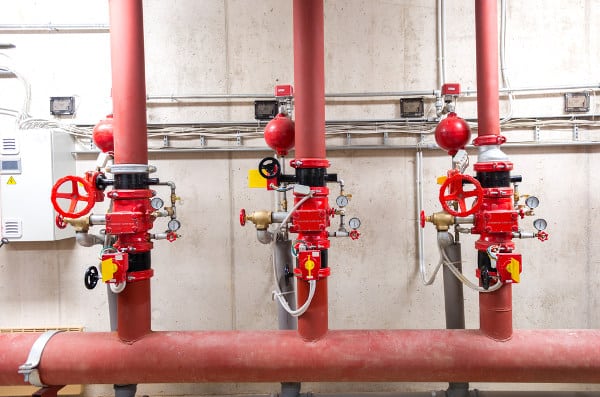
1. Fire Gate Valve
Function
Gate valves provide full-flow shutoff in fire protection piping. The wedge-shaped gate moves perpendicular to flow, creating minimal pressure drop when fully open.
Key Specifications
| Parameter | Typical Range |
|---|---|
| Size | 2" to 12" (DN50 to DN300) |
| Pressure rating | 175 PSI (12 bar) to 300 PSI (20.7 bar) |
| Material | Ductile iron body, bronze/brass trim |
| Connection | Flanged, grooved, or threaded |
| Standard | UL 262, FM 1120 |
Applications
Main system control valves - isolating building sprinkler systems from municipal water supplies
Pump discharge and suction lines
Tank outlet connections
Installation Best Practice
🔧 Tip: Gate valves in fire protection systems should be supervised (equipped with tamper switches) to ensure they remain in the open position. A closed gate valve is a leading cause of sprinkler system failure.
CA-FIRE Product: OS&Y Gate Valve
Our Outside Screw and Yoke (OS&Y) gate valves feature visible stem position indication, making it easy to verify the valve is fully open. Available with FM, UL, and CCCF certifications.
2. Fire Butterfly Valve
Function
Butterfly valves use a rotating disc to control flow. They are lighter and more compact than gate valves, making them ideal for large-diameter piping where space is limited.
Types of Fire Butterfly Valves
| Type | Feature | Application |
|---|---|---|
| Wafer type | Fits between flanges, no lug bolts | Light-duty, temporary installations |
| Lug type | Threaded lugs for bolt-through mounting | Permanent installations, higher pressure |
| Grooved end | Victaulic-style coupling connection | Fast installation in commercial buildings |
Signal Butterfly Valves
Signal butterfly valves include a supervisory switch that transmits the valve position to the fire alarm control panel. This is required by NFPA 13 for all control valves in sprinkler systems.
CA-FIRE Product: Fire Signal Butterfly Valve
Our fire signal butterfly valves feature:
Visual position indicator (open/closed)
Tamper-proof switch (SPDT, 10A @ 125/250V AC)
Grooved or flanged connections
Pressure rating: 175 PSI (12 bar) standard, 300 PSI optional
3. Fire Check Valve (Non-Return Valve)
Function
Check valves allow water to flow in one direction only, preventing backflow and maintaining system pressure. They are critical for:
Preventing drainage of elevated piping
Protecting fire pumps from backspin
Maintaining priming in fire pump suction lines
Types of Fire Check Valves
| Type | Mechanism | Best For |
|---|---|---|
| Swing check | Hinged disc swings open with flow | Horizontal piping, low-velocity systems |
| Silent check | Spring-loaded disc | Vertical piping, high-velocity systems |
| Rubber-flap check | Flexible elastomer flap | Corrosive water conditions |
Installation Note
Check valves must be installed with the flow arrow pointing in the correct direction. In vertical installations, spring-loaded (silent) check valves are required to ensure reliable closure.
CA-FIRE Product: Fire Check Valve
Available in ductile iron and stainless steel construction, with FM/UL approval for pressures up to 300 PSI.
4. Alarm Check Valve
Function
The alarm check valve is the heart of a wet pipe sprinkler system. It:
Allows water to flow to sprinklers when the system activates
Prevents backflow into the water supply
Triggers water motor gongs and pressure switches for alarm notification
How It Works
In standby, water pressure holds the clapper closed against the system side
When a sprinkler opens, pressure drops on the system side
The clapper opens, allowing water flow
Water flows through the alarm line to activate alarms
Key Components
| Component | Function |
|---|---|
| Clapper assembly | Main sealing element, rubber-faced |
| Alarm line trim | Includes retard chamber, pressure switch, water motor gong |
| Bypass check valve | Allows pressure equalization during normal fluctuations |
| External bypass | Prevents false alarms from pressure surges |
CA-FIRE Product: Wet Alarm Check Valve
Our wet alarm check valves are available in sizes from 2" to 8" (DN50 to DN200), with:
Retard chamber to prevent false alarms from water hammer
Trim package including pressure switch and water motor gong
FM, UL, and CCCF certifications
5. Deluge Valve
Function
Deluge valves are solenoid or pneumatically actuated control valves that release water to open sprinkler heads in deluge systems. Unlike alarm check valves, deluge valves are normally closed and require an external signal to open.
Actuation Methods
| Method | Trigger | Response Time | Best For |
|---|---|---|---|
| Pneumatic | Air pressure drop from broken pilot line | Fast | Explosion-risk areas |
| Electric solenoid | Fire alarm panel signal | Fast | Standard industrial applications |
| Manual release | Human operator | Immediate | Emergency override |
| Hydraulic | Water pressure from pilot sprinkler | Medium | Specialized applications |
System Requirements
Deluge valves require:
Detection system (flame detectors, heat detectors, or pilot sprinklers)
High-capacity water supply (often dedicated fire pump)
Foam concentrate injection (for Class B flammable liquid hazards)
CA-FIRE Product: Deluge Valve
Our deluge valves feature:
Multiple actuation options (pneumatic, electric, manual)
Reset capability without draining the system
Pressure rating: 300 PSI (20.7 bar)
Sizes: 2" to 8" (DN50 to DN200)
Fire Valve Selection Guide
Use this table to match valve type to system requirements:
| Application | Recommended Valve | Why |
|---|---|---|
| Main system isolation | OS&Y Gate Valve | Full flow, positive shutoff, visible position |
| Large-diameter control (4"+) | Butterfly Valve | Compact, lightweight, cost-effective |
| System supervision required | Signal Butterfly Valve | Built-in tamper switch |
| Backflow prevention | Check Valve | One-way flow, protects pumps |
| Wet pipe sprinkler system | Alarm Check Valve | Alarm activation, backflow prevention |
| Deluge/foam system | Deluge Valve | External actuation, rapid flooding |


