

What Is the Difference Between Jet and Spray Patterns in Fire Monitors?
Leave a message
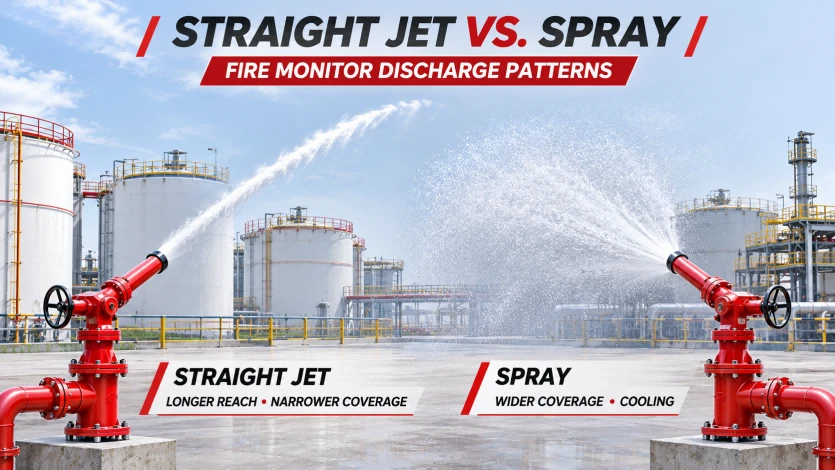
Fire monitors are widely used in industrial facilities, oil terminals, warehouses, and other locations requiring high-capacity firefighting equipment. Depending on the nozzle design and operating conditions, a fire monitor can produce different discharge patterns, mainly straight jet and spray.
Understanding the differences helps project teams select suitable equipment for specific fire protection applications.
What Is a Straight Jet Pattern?
A straight jet produces a concentrated stream of water with relatively high momentum. It is designed to deliver water over a longer distance, making it suitable for applications where the fire source is far from the monitor location.
Common applications include:
Outdoor industrial storage areas
Large factory yards
Tank farms and loading areas
Long-distance firefighting operations
The actual throw distance depends on factors such as flow rate, operating pressure, nozzle design, elevation, and wind conditions.
What Is a Spray Pattern?
A spray pattern distributes water into multiple droplets over a wider area. Compared with a straight jet, it generally provides broader coverage but has a shorter effective reach.
Spray discharge may be useful for:
Cooling exposed equipment and surrounding surfaces
Wetting larger areas
Reducing radiant heat exposure
Protecting nearby structures during firefighting operations
Spray performance depends on droplet size, nozzle configuration, pressure, and environmental conditions.
Jet vs. Spray: Key Differences
| Comparison | Straight Jet | Spray |
|---|---|---|
| Water Discharge | Concentrated stream | Distributed droplets |
| Coverage | Narrower | Wider |
| Effective Reach | Generally longer | Generally shorter |
| Main Function | Long-distance water delivery | Area coverage and cooling |
| Typical Application | Direct firefighting | Exposure protection and cooling |
How to Choose the Right Fire Monitor Pattern
The selection should be based on the fire hazard, required flow rate, operating pressure, target distance, and coverage area.
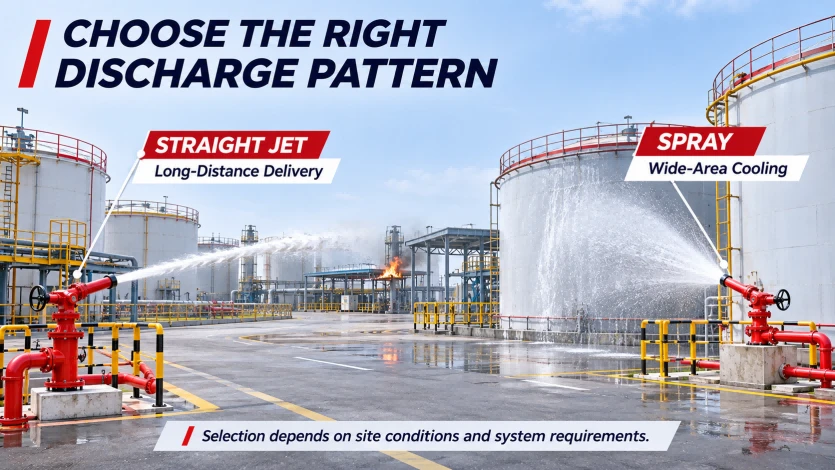
For facilities with large outdoor spaces or distant fire hazards, a straight jet may be more suitable. Where cooling and wider surface coverage are important, a spray pattern may be preferred.
Some fire monitors are designed to switch between jet and spray patterns, providing greater operational flexibility. Buyers should confirm the available discharge modes, flow range, nozzle type, and operating pressure before ordering.
Final Considerations
Jet and spray patterns serve different firefighting purposes. Neither is universally better; the appropriate choice depends on the site layout and fire protection requirements.
CA-FIRE provides fire monitors for industrial fire protection applications. Contact our team with your required flow rate, operating pressure, connection size, and discharge pattern to discuss suitable product options.


