

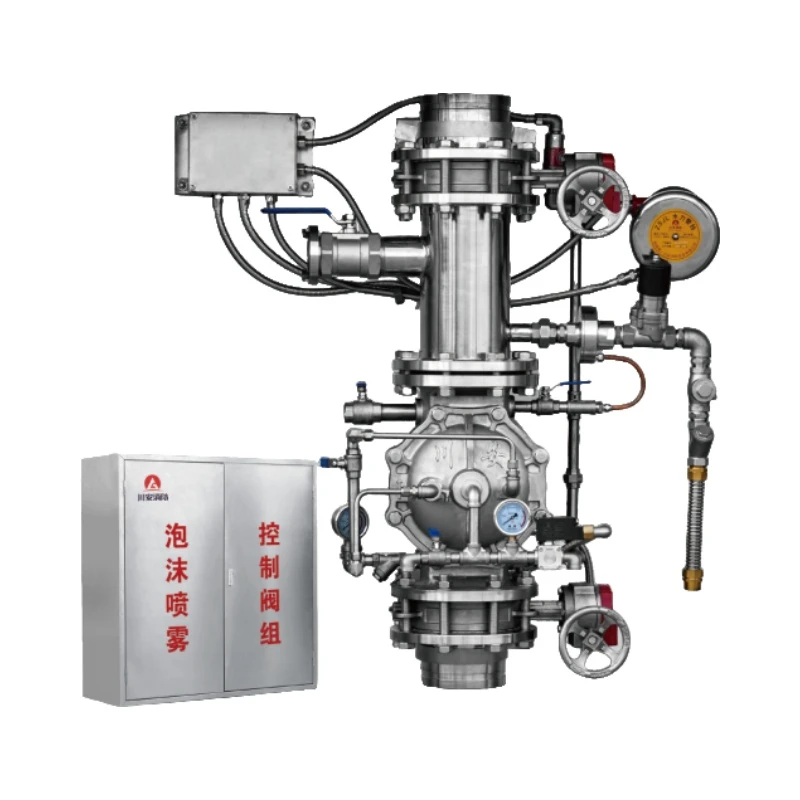
PHPD Series Foam-Water Deluge System Tunnel Foam Spray System
PHPD Series Foam-Water Combination Deluge System integrates a deluge valve group with a balanced-pressure foam proportioning device to provide rapid tunnel fire protection. It delivers a stable foam-water mixture through spray nozzles, creating a fire-smothering foam blanket for oil and fuel hazards. Designed for reliable performance in demanding industrial applications.
Description
Ca-Fire Protection Co.,Ltd is one of the most credible manufacturers and suppliers of phpd series foam-water deluge system tunnel foam spray system in China. Welcome to wholesale custom made fire equipment products at competitive price from our factory. Contact us for more cheap products.
Products Description
Tunnel Foam Spray
Deluge Valve Group
A combined deluge valve and balanced-pressure foam proportioning assembly. On activation, it discharges an atomized foam-water mixture over the fire zone - cutting off oxygen and building a suffocating blanket in the critical opening seconds of tunnel deluge operation.
0.6–1.2 MPa
Working Pressure
4°C
Min. ambient temp
50·
RTI ≤ (m·s)^0.5
Atmospheric
Foam Tank Type
2 Models
PHPD64 · PHPD75
Grooved / Flanged
Connection Type
GB 20031-2005
Executive Standard
Product Overview
Two systems, one valve group
Built for tunnel spaces carrying oil-fire risk, where an early, self-sustaining foam attack matters more than raw water volume.
The PHPD tunnel foam spray control valve group combines a deluge valve set with a balanced-pressure foam proportioning device into a single installed unit. In the opening phase of deluge system operation, it discharges an atomized foam-water mixture rather than plain water - the foam spreads and settles across the fire area surface as it discharges, isolating the fuel from air and driving the fire toward suffocation rather than simply cooling it.
Proportioning is handled by the balanced foam mixing device. A foam liquid pump pressurizes concentrate into the proportioner; as pressure and flow in the main line shift with changing fire conditions, a balancing valve continuously regulates the injected foam volume to hold the mixing ratio steady. The result is a consistently proportioned foam-water mixture for the full duration of the discharge, not just at the moment of activation.
The foam liquid tank is atmospheric-pressure rather than pressure-vessel type, which means it can be topped up with concentrate while the system is in service - removing the fixed-capacity limitation that pressure-type foam tanks impose on traditional deluge-foam installations.

Operating Sequence
From detection to suffocation
Three linked stages take the system from a fire signal to a stable, self-regulating foam blanket over the fire area.
Deluge activation
On a fire signal, the deluge valve group opens and admits pressurized water into the pipe network ahead of the affected tunnel section, priming the system for immediate discharge.
Balanced proportioning
The foam liquid pump injects concentrate into the proportioner. As line pressure and flow fluctuate under real operating conditions, the balancing valve adjusts injection to hold the 3%–3.9% mixing ratio steady.
Atomized discharge & isolation
The proportioned mixture atomizes as it discharges, settling progressively across the fire area surface, cutting off air supply and suffocating the fire rather than only cooling it.
Flow Path
How the mixture is built
The proportioning path stays balanced automatically, without manual adjustment during discharge.
| A | Foam Liquid Pump | Draws concentrate from the atmospheric foam tank and pressurizes it toward the proportioner, matching the pressure of the incoming main water line. |
| B | Proportioner | Meters pressurized foam concentrate into the main water stream at the target ratio (3%–3.9%) to form the foam-water mixture. |
| C | Balancing Valve | Continuously senses changes in main-line pressure and flow, and modulates foam injection to keep the mixing ratio constant under varying operating conditions. |
| D | Deluge Valve Group | Controls admission of the proportioned mixture into the downstream nozzle network for atomized discharge over the protected tunnel section. |
Technical Data
Two flow classes, one platform
Select by required mixture flow and pipe diameter for the protected tunnel section.
| Model | Working Pressure (MPa) | Mixture Flow Range (L/s) | Mixing Ratio | Nominal Diameter (mm) | Connection | Standard |
|---|---|---|---|---|---|---|
| PHPD64 | 0.6 – 1.2 | 24 – 64 | 3% – 3.9% | DN100 | Grooved / Flanged | GB 20031-2005 |
| PHPD75 | 0.6 – 1.2 | 30 – 75 | 3% – 3.9% | DN150 | Grooved / Flanged | GB 20031-2005 |
Both models share the same working pressure range and mixing ratio band; flow capacity and nominal diameter scale with the protected section's demand. Custom flow classes available on request.
Advantages
Why balanced-pressure, atmospheric-tank design
Stable ratio under varying flow
The balancing valve tracks real-time changes in main-line pressure and flow, so the mixing ratio doesn't drift as operating conditions shift during discharge.
No fixed capacity ceiling
The atmospheric-pressure foam tank can be replenished while the system is running, removing the limited-capacity constraint of traditional pressure-vessel foam tanks.
Faster fire control in enclosed spaces
Atomized foam settles across the fire surface and isolates it from air, suffocating the fire - more effective than plain water alone in ventilation-limited tunnel bores.
Single combined assembly
Deluge valve group and foam proportioning device are engineered and supplied as one unit, simplifying specification, installation, and commissioning versus separate systems.
Compliant to national standard
Manufactured to GB 20031-2005, with grooved or flanged connection options to match the project's existing pipe network.
Purpose-built for oil-fire risk
Designed specifically for tunnel spaces where flammable-liquid fires are the primary risk - a scenario where foam suppression outperforms water-only deluge.
FAQ
Q: How do I choose between PHPD64 and PHPD75?
A: Match the model to the mixture flow demand and pipe diameter of the protected tunnel section: PHPD64 covers 24–64 L/s on DN100, PHPD75 covers 30–75 L/s on DN150. Send us your section length, hazard classification, and required design flow and our engineers will confirm the right selection.
Q: Why is the foam tank atmospheric rather than pressurized?
A: An atmospheric-pressure tank can be topped up with foam concentrate while the deluge system is in service. A sealed pressure-vessel tank cannot be safely refilled under operating conditions, which caps the total foam volume available for an extended or repeated discharge.
Q: Does the mixing ratio stay accurate if flow changes mid-discharge?
A: Yes. That is the function of the balancing valve - it continuously adjusts foam liquid injection in response to real-time changes in main-line pressure and flow, keeping the ratio within the 3%–3.9% band rather than being fixed at a single design-point flow.
Q: What connection types are available?
A: Both models are available with grooved or flanged connections to match the existing pipe network on site, per GB 20031-2005.
Q: Is this suitable for water-only deluge protection as well?
A: The valve group is engineered specifically as a foam-water combination unit for oil-fire risk areas. For tunnel sections without flammable-liquid risk, a standard deluge valve set without foam proportioning is typically the more economical choice - let us know the hazard profile and we can advise on the right configuration.
Our address
NO.8, YUANFENG ROAD, MEIYUAN VILLAGE, KANGMEI TOWN, NANAN CITY, QUANZHOU CITY, FUJIAN CHINA

Hot Tags: phpd series foam-water deluge system tunnel foam spray system, China phpd series foam-water deluge system tunnel foam spray system manufacturers, suppliers, factory
Send Inquiry
You Might Also Like


