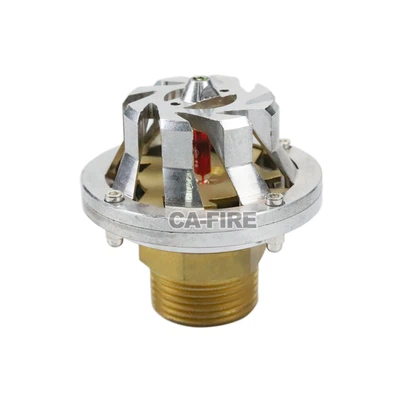
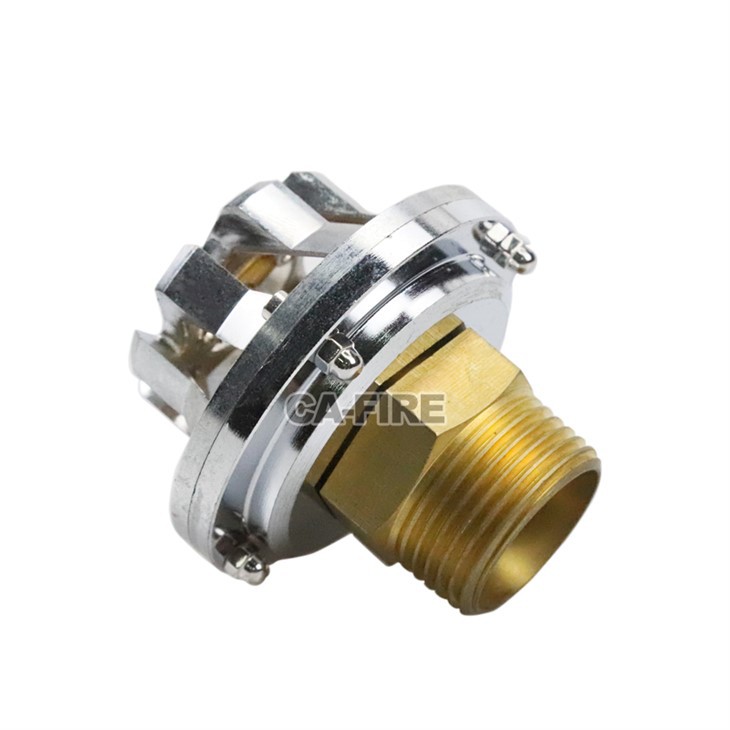
Brass Glass Bulb Deluge Sprinkler For Fire Protection Systems
video
Brass Glass Bulb Deluge Sprinkler For Fire Protection Systems

Brass Glass Bulb Deluge Sprinkler For Fire Protection Systems

A brass glass bulb deluge sprinkler is designed for high-risk fire protection systems requiring rapid and large-area water discharge. Installed in deluge systems, it works with a deluge valve to release water through all sprinklers simultaneously once activated. Made from durable brass material, it offers strong corrosion resistance and reliable performance under high pressure. It is widely used in industrial facilities, chemical plants, and storage areas where fast fire control is essential.

Description

Ca-Fire Protection Co.,Ltd is one of the most credible manufacturers and suppliers of brass glass bulb deluge sprinkler for fire protection systems in China. Welcome to wholesale custom made fire equipment products at competitive price from our factory. Contact us for more cheap products.


Products Description

CA-FIRE Brass Glass Bulb Deluge Sprinkler


CA-FIRE Brass Glass Bulb Deluge Sprinkler

The brass-constructed deluge sprinkler serves as the terminal discharge device in pre-action and deluge suppression networks, specifically engineered for rapid total-flooding applications in severe hazard environments. Fabricated from high-grade copper-zinc alloys, this open-orifice component delivers exceptional resistance to corrosive atmospheres, mechanical fatigue, and thermal cycling-ensuring sustained operational integrity across extended service intervals in demanding industrial settings.

Unlike conventional closed-head systems that rely on individual thermal sensitivity, deluge sprinklers operate as continuously open nozzles integrated with a dedicated detection and actuation infrastructure. System activation occurs through an independent fire detection array-comprising smoke detectors, heat sensors, or optical flame scanners-that signals the deluge valve to release water simultaneously across all protected zones. This collective discharge mechanism ensures instantaneous wetting of the entire hazard area, eliminating the sequential activation delays inherent in standard wet-pipe configurations.

The brass alloy construction provides robust structural performance under elevated operating pressures, while precision-machined orifice geometries engineered to specific K-factors guarantee consistent spray distribution patterns and optimal droplet sizing for effective heat absorption and flame knockdown. These characteristics render deluge sprinklers particularly suitable for high-challenge occupancies such as aircraft hangars, chemical processing facilities, transformer vaults, and foam-water suppression systems where immediate large-volume water application is critical for hazard mitigation.

High-Risk Fire Protection Requires Instant Water Discharge

Chemical processing facilities, flammable liquid storage installations, power generation plants, and large-scale industrial warehousing present acute fire risk profiles characterized by rapid flame propagation and high heat release rates. In such occupancies, ignition events can escalate from localized incidents to fully developed conflagrations within moments, rendering conventional detection-to-suppression intervals insufficient for effective hazard mitigation. Consequently, active fire protection strategies for these environments demand immediate, high-volume water application capable of arresting combustion before critical temperatures or flashover conditions develop.

Deluge suppression networks address this challenge through engineered simultaneous discharge across the entire protected envelope. Where standard wet-pipe systems rely on discrete thermal elements to sequence individual head activation, deluge infrastructure employs independent detection circuitry-whether pneumatic tubing, electronic sensors, or optical flame detectors-to trigger a central deluge valve, releasing water instantaneously through all open-orifice nozzles in the designated zone. This collective actuation eliminates the temporal and spatial delays inherent in sequential sprinkler operation, ensuring comprehensive surface wetting and oxygen displacement from the outset of the suppression event.

Within this hydraulic architecture, the deluge sprinkler functions as the critical interface between system infrastructure and hazard control. Its open-port design accommodates abrupt flow initiation at rates significantly exceeding conventional closed-head systems, while precision-engineered deflector geometries maintain spray uniformity and droplet momentum across wide-area coverage patterns. This coordinated hydraulic performance proves essential for safeguarding high-value capital equipment, minimizing operational interruption, and maintaining tenable conditions for occupant egress and emergency response personnel in severe industrial hazard scenarios.

CA-FIRE Brass Glass Bulb Deluge Sprinkler

CA-FIRE Brass Glass Bulb Deluge Sprinkler

Importance of Material Selection in Deluge Sprinkler Performance

The metallurgical specification of deluge sprinkler components constitutes a critical determinant of operational reliability, service longevity, and suppression effectiveness in aggressive fire protection environments. Copper-zinc alloy systems-particularly those conforming to C36000 (free-cutting brass) or C37700 (forging brass) specifications-have established dominance in high-performance deluge applications through their synergistic combination of atmospheric corrosion resistance, tensile strength retention, and hydraulic pressure tolerance .

Industrial and external installations subject sprinklers to cyclic moisture exposure, chemical vapor attack, and thermal stress gradients. In such contexts, brass substrates demonstrate superior resistance to dezincification and stress-corrosion cracking compared to ferrous alternatives, preserving dimensional stability of orifice geometries and deflector alignments across extended operational lifespans. This structural consistency proves vital during emergency activation events, where any degradation in nozzle contour or spray trajectory could compromise the design density distribution required for effective fire control.

Furthermore, the excellent machinability characteristics of brass alloys-typically achieving surface finishes of 32 μin RMS or finer-facilitate precision manufacturing tolerances critical to hydraulic performance. Uniform orifice diameters and symmetric deflector profiles ensure consistent K-factor maintenance and droplet size distribution, enabling the deluge system to achieve instantaneous saturation coverage across the calculated protection area upon valve actuation. Material specification thus functions as a foundational engineering decision, directly influencing the probability of successful suppression, system availability, and lifecycle cost efficiency in severe-service fire protection installations.

CA-FIRE Brass Glass Bulb Deluge Sprinkler

System Coordination and Spray Distribution Efficiency

The operational efficacy of deluge suppression networks depends upon the synchronized hydraulic performance of all constituent elements-from detection circuitry through piping infrastructure to terminal discharge devices. In severe hazard scenarios involving flammable liquid exposures or high-challenge combustible storage, the simultaneous achievement of design density across the entire protected envelope becomes paramount, as localized application inadequacies can permit fire extension beyond the initial fuel array, resulting in catastrophic escalation before manual intervention becomes feasible.

Individual deluge sprinklers function as distributed hydraulic nodes within this integrated system, each engineered to maintain specific trajectory angles, droplet velocity distributions, and spray cone geometries that collectively establish uniform water flux across three-dimensional hazard volumes. Precision-machined orifice configurations and optimized deflector profiles ensure penetration into concealed spaces, elevated structural elements, and complex equipment geometries where flame propagation might otherwise establish secondary ignition points unchecked by overhead discharge patterns.

This engineered distribution efficiency yields dual operational advantages: the minimization of non-effective water application that would otherwise contribute to runoff and water damage, alongside the maximization of heat absorption rates and oxygen displacement at the combustion interface. When synchronized with rapid-opening deluge valve actuation and adequately sized piping networks designed through hydraulic calculations per NFPA 15 or equivalent standards, brass-constructed open sprinklers constitute the terminal elements of a cohesive protection strategy-safeguarding human occupants, critical infrastructure, and operational continuity through immediate, dependable hydraulic response in demanding industrial environments.

Deluge Sprinkler FAQ

1. What is a deluge sprinkler used for?
A deluge sprinkler is used in high-hazard fire protection systems to provide instant water discharge over a large area. It is commonly used in chemical plants, oil storage areas, power stations, and industrial facilities.

2. How does a deluge sprinkler system work?
In a deluge system, all sprinklers are open-type. When the deluge valve is activated by a detection system, water is released immediately and flows through all sprinklers at the same time, covering the entire protection zone.

3. What is the difference between a deluge sprinkler and a standard sprinkler?
A standard sprinkler activates individually when heat reaches a certain temperature, while a deluge sprinkler system activates all nozzles simultaneously through a control valve, providing much faster and wider water coverage.

4. Why is brass used in deluge sprinklers?
Brass is commonly used because it offers excellent corrosion resistance, high mechanical strength, and stable performance under high-pressure conditions, making it suitable for demanding industrial fire protection environments.

5. Where are deluge sprinklers typically installed?
They are installed in high-risk areas such as petrochemical facilities, fuel storage tanks, industrial warehouses, power plants, and other locations where rapid fire spread control is required.

How To Cooperate With Us?
 

Our address

NO.8, YUANFENG ROAD, MEIYUAN VILLAGE, KANGMEI TOWN, NANAN CITY, QUANZHOU CITY, FUJIAN CHINA

 
WhatsApp

+86 18160950625


E-mail

miki@ca-fire.com

product-943-596


Hot Tags: brass glass bulb deluge sprinkler for fire protection systems, China brass glass bulb deluge sprinkler for fire protection systems manufacturers, suppliers, factory

You Might Also Like

Shopping Bags