
What is the maximum height that China fire hydrants can supply water to?
Leave a message

As a dedicated supplier of China fire hydrants, I often encounter an inquiry that piques the interest of many in the industry and beyond: What is the maximum height that China fire hydrants can supply water to? This question delves into the heart of fire hydrant functionality, bearing significant implications for fire safety and building design, especially in regions where high - rise structures are prevalent.
The Basics of Fire Hydrant Water Supply
Fire hydrants are a cornerstone of urban fire protection infrastructure. In China, these devices are designed to provide a reliable and consistent water source during firefighting operations. The water supply comes from various sources, including municipal water systems, fire - fighting water tanks, and underground water pipes.
The ability of a fire hydrant to supply water to a certain height depends primarily on two factors: water pressure and the flow rate. Water pressure is the force that pushes water through the pipes and hoses to the desired height. Flow rate, on the other hand, refers to the volume of water that can be delivered per unit of time. A sufficient flow rate is crucial for effectively extinguishing fires, as it ensures an adequate amount of water reaches the fire scene.
Technical Limitations and Standards
In China, the standards for fire hydrants are well - defined by national regulations and industry best practices. These standards ensure the safety and reliability of fire hydrants across the country. The maximum height that a fire hydrant can supply water is closely related to the design and performance of the entire fire - fighting water supply system.
Typically, the water pressure provided by municipal water systems in China ranges from 0.1 MPa to 0.6 MPa. According to the principles of fluid mechanics, for every 10 meters of vertical height increase, the water pressure needs to be increased by approximately 0.1 MPa to overcome the gravitational force. Therefore, if we only consider the water pressure from the municipal water system, the theoretical maximum height that water can be supplied is around 60 meters.
However, in practical firefighting operations, additional factors need to be taken into account. Friction loss in pipes and hoses reduces the available water pressure. As water flows through pipes, it encounters resistance from the inner walls of the pipes, which dissipates some of the energy. The length, diameter, and material of the pipes all affect the friction loss. For example, a longer pipe or a pipe with a smaller diameter will result in greater friction loss.
Solutions to Increase the Supply Height
To overcome the limitations imposed by water pressure and friction loss, China has developed several effective solutions. One of the most common methods is the use of fire pumps. Fire pumps are installed in buildings or fire stations to increase the water pressure. These pumps can boost the pressure of the water supply, allowing it to reach greater heights.
In high - rise buildings, a multi - stage fire - fighting water supply system is often adopted. This system consists of a combination of fire hydrants, fire pumps, and water tanks at different levels. The lower - level fire hydrants are connected to the municipal water system, while the upper - level fire hydrants are supplied by the water tanks and pumps installed on intermediate floors. This staged approach ensures a stable water supply to all floors of the building.
Products for Different Height Requirements
As a fire hydrant supplier, we offer a diverse range of products to meet different height requirements. Our Double Pillar Outlet Fire Hydrant is a popular choice for both low - rise and mid - rise buildings. It features two outlets, which can provide a larger flow rate and is suitable for situations where multiple fire hoses need to be connected simultaneously.
For high - rise buildings, our CA - FIRE Double Outlet Fire Hydrant is designed to work in conjunction with high - pressure fire - fighting systems. It is made of high - quality materials and has a robust structure to withstand the high water pressure.
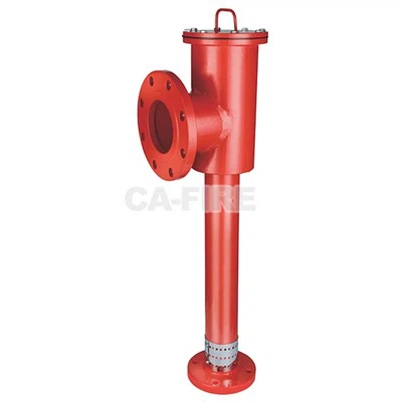
In addition, our T Type Vertical Fire Hydrant is a space - saving and efficient option. It can be easily installed in narrow spaces and is often used in buildings with limited installation areas.
Real - world Applications
In modern Chinese cities, high - rise buildings are everywhere, and the demand for effective fire protection is increasing. For example, in Shanghai, many skyscrapers are equipped with state - of - the - art fire - fighting water supply systems. These systems can ensure that water can be supplied to the top floors of the buildings, even in the event of a fire.


In some large - scale industrial parks, fire hydrants are also an essential part of the fire protection infrastructure. The fire hydrants in these areas need to be able to supply water over long distances and to different heights to meet the diverse needs of the industrial facilities.
Conclusion and Call to Action
The maximum height that China fire hydrants can supply water to is a complex issue that is influenced by multiple factors. Through continuous technological innovation and strict adherence to standards, the Chinese fire - fighting industry has been able to provide effective solutions for different height requirements.
As a supplier, we are committed to providing high - quality fire hydrants and related products. Whether you are a building developer, a facility manager, or a firefighting professional, our products can meet your needs. If you are interested in our fire hydrants or have any questions about water supply height and fire protection systems, please feel free to contact us for a detailed consultation. We look forward to working with you to enhance fire safety.
References
- National Fire Protection Association (NFPA) standards.
- Chinese national standards for fire hydrants and fire - fighting water supply systems.
- Technical papers on fluid mechanics and fire - fighting engineering.