

Difference Between Fire Hydrant And Fire Monitor: Applications, Working Principles And Key Differences
Leave a message
Introduction
Fire hydrants and fire monitors are both important water-based fire protection equipment used for firefighting operations. Although they both provide water for fire suppression, they are designed for different applications.
A fire hydrant mainly provides a connection point for firefighters to manually connect hoses and supply water, while a fire monitor delivers a powerful and controllable water stream over a long distance for large-scale fire suppression.
Understanding the difference between fire hydrants and fire monitors helps engineers select the right firefighting equipment for buildings, industrial facilities, ports, airports, and hazardous areas.
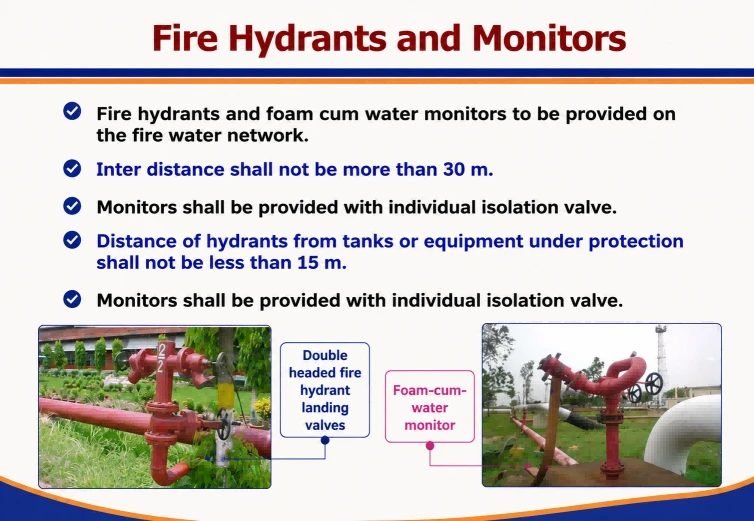
What Is a Fire Hydrant?
A fire hydrant is a fixed water outlet connected to a fire water supply system. It allows firefighters to connect fire hoses and use the available water supply for manual firefighting.
Fire hydrants are commonly installed in:
Commercial buildings
Residential areas
Industrial plants
Warehouses
Roads and public areas
Oil and gas facilities
During a fire emergency, firefighters connect hoses to the hydrant outlet and manually control the nozzle direction and water discharge.
Main Features of Fire Hydrants:
Connected to underground or above-ground water networks
Provides reliable water supply points
Requires manual hose operation
Suitable for close-range firefighting
Available in indoor and outdoor types
Common types include:
Outdoor fire hydrant
Indoor fire hydrant
Underground fire hydrant
Foam fire hydrant
What Is a Fire Monitor?
A fire monitor, also called a fire water cannon, is a firefighting device designed to discharge large amounts of water or foam solution over a long distance.
Unlike a hydrant, a fire monitor usually includes a directional control mechanism that allows operators to adjust the horizontal and vertical spray direction.
Fire monitors are widely used in:
Oil terminals
Chemical plants
Airports
Tank farms
Offshore platforms
Large industrial facilities
Main Features of Fire Monitors:
High flow rate
Long discharge distance
Adjustable water stream direction
Suitable for large-area fire protection
Available in manual and remote-controlled versions
Common types include:
Manual fire monitor
Electric remote control fire monitor
Explosion-proof fire monitor
Water foam monitor
Fire Hydrant vs Fire Monitor: Key Differences
| Item | Fire Hydrant | Fire Monitor |
|---|---|---|
| Main Function | Water supply connection | Long-range fire suppression |
| Operation | Manual hose connection | Manual or remote control |
| Water Flow | Medium flow rate | High flow rate |
| Range | Short to medium distance | Long-distance discharge |
| Control | Controlled by hose nozzle | Adjustable direction and angle |
| Application | Buildings and general firefighting | Industrial and high-risk areas |
| Installation | Fire water network | Fixed firefighting system |
Difference in Working Principle
Fire Hydrant Working Principle
A fire hydrant provides access to the pressurized fire water pipeline. When opened, water flows from the main pipeline through the hydrant outlet to the connected hose.
Firefighters then control the water spray using a fire nozzle.
Water supply → Fire hydrant → Fire hose → Fire nozzle → Fire suppression
Fire Monitor Working Principle
A fire monitor directly discharges a large volume of water or foam through a specially designed nozzle.
The monitor body allows adjustment of:
Horizontal rotation
Vertical elevation angle
Spray pattern
Fire water pipeline → Fire monitor → High-pressure water/foam discharge → Long-range suppression
Which One Should Be Used?
Fire Hydrant Applications
Fire hydrants are suitable when:
✓ Firefighters need a reliable water connection
✓ Manual firefighting operation is required
✓ Buildings require standard fire protection systems
✓ Fire hose deployment is practical
Typical applications:
Office buildings
Shopping malls
Residential buildings
Factories
Fire Monitor Applications
Fire monitors are preferred when:
✓ Large fire hazards exist
✓ Long-distance water discharge is required
✓ Manual approach is dangerous
✓ Large flow capacity is needed
Typical applications:
Petroleum storage tanks
Chemical facilities
Airports
Ports
Power plants
Can Fire Hydrants and Fire Monitors Work Together?
Yes. In many industrial fire protection systems, fire hydrants and fire monitors are installed together.
For example:
Fire hydrants provide water supply points for firefighters.
Fire monitors provide rapid large-area cooling and fire suppression.
This combination improves firefighting efficiency, especially in high-risk industrial environments.
Conclusion
The main difference between a fire hydrant and a fire monitor is their purpose and firefighting capability.
A fire hydrant is mainly used as a manual water supply point, while a fire monitor is designed for high-flow, long-range fire suppression.
Selecting the correct equipment depends on the application environment, fire risk level, required flow rate, and protection design requirements.
For commercial buildings, fire hydrants are usually essential. For industrial facilities with large fire hazards, fire monitors provide additional protection and faster response capability.


