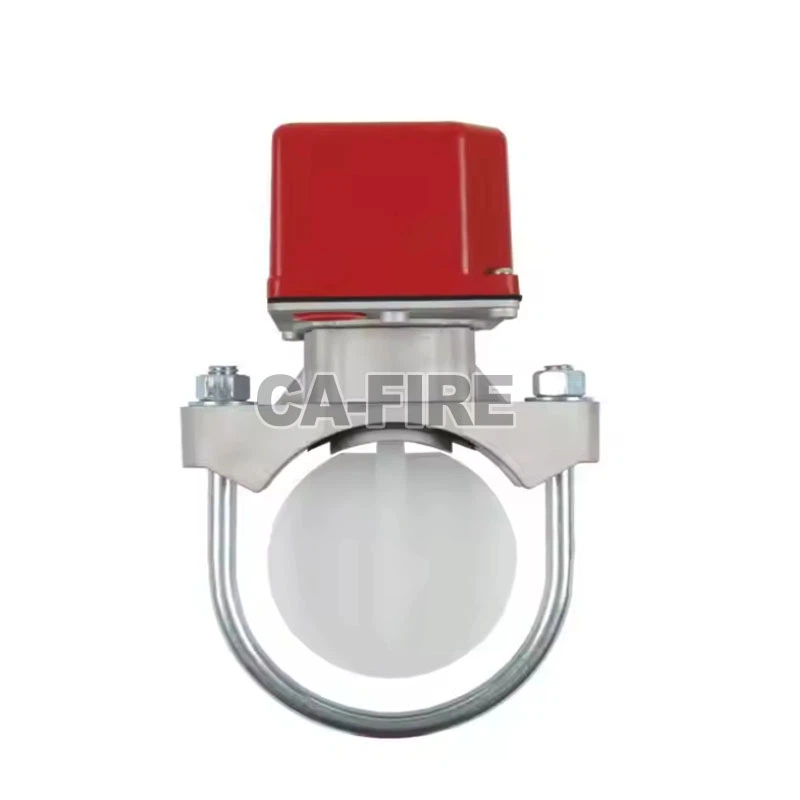
The saddle type water flow indicator functions as a specialized hydraulic sensing apparatus engineered to monitor fluid dynamics within pressurized conduit networks and transduce mechanical displacement phenomena into actionable electrical intelligence for integrated fire command and control architectures. Its operational methodology embodies elegant simplicity combined with exceptional functional dependability, establishing it as an indispensable element for continuous status surveillance within automatic suppression infrastructures.
The activation sequence commences upon thermal discharge of fusible sprinkler elements within a protected zone. This event precipitates immediate decompression of the network segment, inducing bulk fluid translation from static equilibrium toward active discharge points. The resulting hydraulic momentum manifests as directional mass flow within distribution piping, generating sufficient kinetic energy to overcome the resting inertia of the internal sensing element. This paddle-shaped obstruction, fabricated from corrosion-resistant metallic alloys and precisely dimensioned to present appropriate frontal area to the flow stream, experiences resultant force displacement proportional to volumetric throughput rates.
Mechanical signal amplification occurs through an articulated lever transmission system housed within the indicator body. The initial paddle excursion, measured in mere millimeters at nominal alarm thresholds, undergoes geometric multiplication through carefully calculated lever arm ratios, yielding amplified displacement capable of reliable switch actuation. This kinematic chain maintains precise tolerances throughout its travel envelope, ensuring consistent triggering characteristics across the specified sensitivity range of fifteen to thirty-seven and one-half liters per minute while rejecting sub-threshold disturbances associated with thermal expansion, minor leakage compensation, or pneumatic preaction system recharge events.
Upon attainment of predetermined angular displacement, the transmission interface engages a hermetically sealed microswitch assembly. This electromechanical transducer exhibits rapid contact state transition, typically achieving full electrical continuity or interruption within milliseconds of mechanical engagement. The switching element offers configurable contact architecture, presenting either normally open or normally closed initial conditions to accommodate diverse supervisory circuit topologies and fail-safe operational philosophies prevalent in contemporary alarm system designs.
The Importance of Water Flow Monitoring in Fire Protection Systems
In fire protection systems, monitoring water flow is one of the most reliable ways to confirm that the system is actively responding to a fire. Unlike pressure gauges or manual inspections, water flow provides a direct indication that a sprinkler has been activated and water is being delivered where it is needed.
1. Immediate Confirmation of System Activation
When a fire occurs and a sprinkler head opens, water begins to flow through the pipeline. Detecting this flow allows the system to:
Confirm that the fire suppression process has started
Provide real-time feedback to the control panel
Eliminate uncertainty about system status
This immediate confirmation is essential for fast and effective emergency response.
2. Accurate Identification of Fire Location
In large or multi-zone systems, knowing where the fire has occurred is critical.
Water flow monitoring helps:
Identify the exact pipeline or zone where flow is detected
Pinpoint the affected area quickly
Support targeted firefighting efforts
This reduces response time and minimizes potential damage.
3. Enabling Automatic System Response
Modern fire protection systems rely heavily on automation. Water flow signals can be used to:
Trigger audible and visual alarms
Activate fire pumps or backup systems
Send alerts to building management or monitoring centers
Without flow detection, these automated responses may be delayed or not triggered at all.
4. Reducing False Alarms and System Errors
Advanced flow monitoring devices are designed with delay functions that filter out temporary disturbances.
This ensures:
Only sustained water flow triggers alarms
Pressure fluctuations do not cause false signals
The system remains stable and reliable
Accurate monitoring improves overall system credibility and performance.
5. Protecting System Integrity
Uncontrolled or unnoticed flow conditions can lead to system inefficiencies or damage.
By monitoring water flow, the system can:
Detect abnormal conditions early
Prevent potential equipment stress or failure
Maintain proper operating conditions
6. Supporting Compliance and Safety Standards
Fire protection codes and standards often require reliable flow monitoring as part of system design.
Proper implementation helps:
Meet regulatory requirements
Pass inspections and certifications
Ensure long-term operational safety
Where Saddle Type Water Flow Indicators Are Commonly Used
Saddle type water flow indicators are widely applied in fire protection systems and water distribution networks where reliable flow detection and easy installation are required. Their unique saddle-mounted design makes them especially suitable for both new projects and retrofit installations.
1. Automatic Fire Sprinkler Systems
The most common application is in automatic sprinkler systems.
They are typically installed on:
Main supply pipelines
Distribution mains
Branch lines for zone monitoring
In these systems, the indicator detects water movement when a sprinkler is activated and sends a signal to the fire alarm panel, helping identify the fire location and trigger alarms.
2. Fire Pump and Alarm Valve Systems
Saddle type water flow indicators are often used together with fire pumps and alarm valve assemblies.
Applications include:
Downstream of alarm valves
Pump discharge pipelines
System monitoring points
They provide confirmation that water is flowing after system activation, supporting coordinated system response.
3. Commercial and Public Buildings
Widely used in buildings with complex fire protection networks, such as:
Shopping malls
Office buildings
Hotels
Hospitals
These environments require accurate zone monitoring to quickly locate fire incidents and ensure occupant safety.
4. Industrial Facilities and Warehouses
In industrial and storage environments, fire protection systems often cover large areas.
Saddle type water flow indicators are used to:
Monitor different protection zones
Ensure rapid detection in large spaces
Support high-reliability system operation
They are particularly useful in logistics centers and manufacturing plants.
5. High-Rise Buildings
For multi-story buildings, fire systems are divided into multiple zones.
The indicator helps:
Track water flow on different floors
Improve fire location accuracy
Enhance system control and management
6. Retrofit and Upgrade Projects
One of the biggest advantages of saddle type indicators is their suitability for retrofit projects.
Why they are ideal:
Installed without cutting existing pipelines
Minimal disruption to system operation
Faster and more cost-effective upgrades
This makes them a preferred choice when modernizing older fire protection systems.