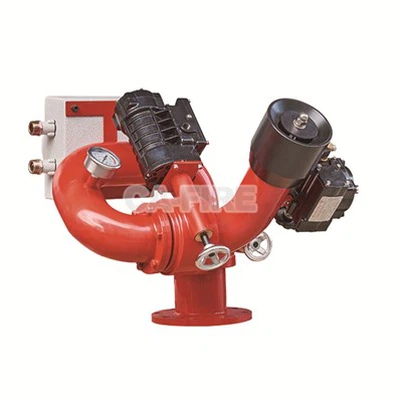


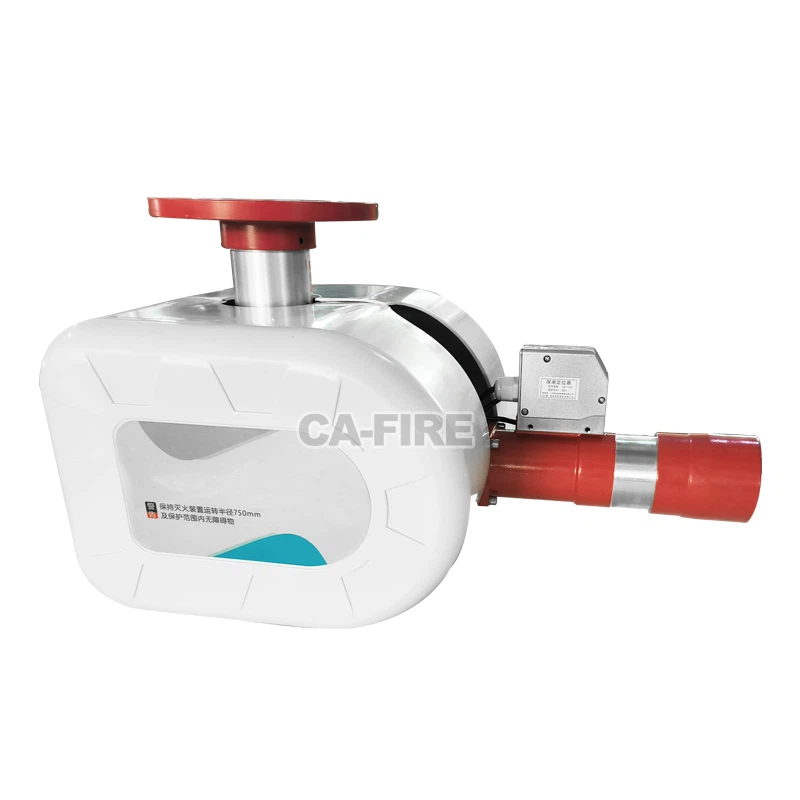


Within intelligent fire-protection architectures, the sensory subsystem and emergency-response decision logic constitute the principal determinants of both detection latency and on-site suppression accuracy. Conventional fire-safety infrastructure generally depends upon isolated detection modalities-such as discrete photoelectric smoke detectors or thermocouple-based thermal sensors-whereas intelligent fire-water-monitor systems employ heterogeneous sensor-fusion architectures integrated with edge-based computational analytics to improve operational resilience and materially suppress spurious-activation events.
The detection pipeline commences with persistent environmental surveillance. High-resolution infrared thermal arrays continuously monitor ambient thermal-field dynamics, while concurrent visible-spectrum imaging modules capture optical data and execute feature-extraction algorithms to discriminate combustion signatures-including oscillation frequencies, radiative spectral patterns, and spatial displacement vectors. Through the synergistic integration of multi-source heterogeneous data streams, the architecture can effectively discriminate against and attenuate nuisance stimuli such as direct solar irradiation, specular reflections, and thermally active industrial machinery, thereby ensuring authentic hazard recognition.
Upon acquisition of anomalous risk indicators, the system invokes a cascaded confidence-validation protocol. Multi-channel surveillance datasets undergo cross-correlation analysis and logical verification before a fire event is affirmatively declared. This hierarchical verification methodology proves particularly indispensable in complex industrial deployment scenarios, where it prevents unwarranted system actuation triggered by transient interference signals.
Following affirmative hazard confirmation, the spatial-localization engine computes precise incident coordinates through geometric intersection methods, coordinate georeferencing alignment, and tessellated zone adjudication. The central control processor subsequently generates high-fidelity servo-positioning commands, actuating the fire-water monitor through synchronized azimuth and elevation adjustments to align the discharge nozzle directly with the combustion origin.