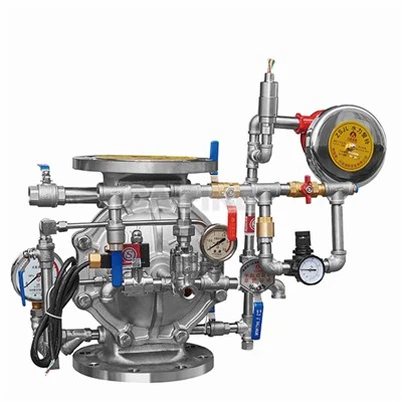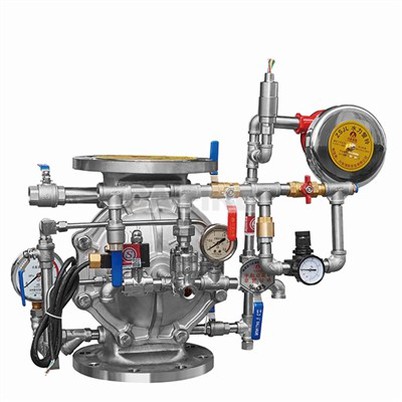


Flange Deluge Valve
This series of intelligent Flange Deluge Valve is a next-generation fire control device developed for extreme conditions such as polar regions and high-altitude areas. Constructed with QT450-12 high-toughness ductile iron (graphite spheroidization rate ≥95%), it integrates "dual-diaphragm sealing + intelligent pressure self-adaptation" technology, overcoming the pain points of traditional deluge valves such as "low-temperature failure and response lag". It is suitable for scenarios like polar research stations, high-altitude oil depots, and ultra-low temperature warehouses. Within a wide temperature range of -40℃~+80℃, it can achieve ultra-fast opening within ≤5s. With a nominal working pressure of 1.6MPa, the sealing test pressure reaches 3.5MPa, meeting the fire protection reliability requirements in extreme environments.
Description
Ca-Fire Protection Co.,Ltd is one of the most credible manufacturers and suppliers of flange deluge valve in China. Welcome to wholesale custom made fire equipment products at competitive price from our factory. Contact us for more cheap products.
Products Description

Flange Deluge Valve
This series of intelligent Flange Deluge Valve is a next-generation fire control device developed for extreme conditions such as polar regions and high-altitude areas. Constructed with QT450-12 high-toughness ductile iron (graphite spheroidization rate ≥95%), it integrates "dual-diaphragm sealing + intelligent pressure self-adaptation" technology, overcoming the pain points of traditional deluge valves such as "low-temperature failure and response lag". It is suitable for scenarios like polar research stations, high-altitude oil depots, and ultra-low temperature warehouses. Within a wide temperature range of -40℃~+80℃, it can achieve ultra-fast opening within ≤5s. With a nominal working pressure of 1.6MPa, the sealing test pressure reaches 3.5MPa, meeting the fire protection reliability requirements in extreme environments.
| Technical Item | Specification |
|---|---|
| Design Standard | GB 5135.5-2019 + Polar Condition Enhancement Specification |
| Flange Standard | GB/T 17241.6 (compatible with ASME B16.5 Class150) |
| Nominal Working Pressure (PN) | 1.6MPa |
| Ultimate Test Pressure | 3.5MPa (pressure holding for 2h at -40℃) |
| Main Body Material | QT450-12 Ductile Iron (impact toughness ≥15J/cm² at -60℃) |
| Applicable Medium | Fire Water, Antifreeze Foam Mixture (mixing ratio 3%-8%) |
Structural Innovation and Material Revolution
3.1 Dual-Diaphragm Adaptive Sealing System
The original "primary diaphragm (NBR) + secondary diaphragm (perfluoroether rubber)" dual-stage sealing structure is adopted. The primary diaphragm is responsible for sealing under normal conditions, and the secondary diaphragm is automatically activated below -40℃, utilizing the low-temperature elasticity of fluororubber to compensate for sealing specific pressure, ensuring a leakage rate ≤0.01mL/min under extreme low temperatures. The diaphragm skeleton adopts 316L stainless steel laser welding technology, with the fatigue resistance increased to 200,000 cycles.
3.2 Polarized Treatment of Ductile Iron
The valve body adopts a "isothermal quenching + deep cryogenic treatment" composite process, increasing the hardness of the ductile iron matrix to HB240-280, with an impact toughness of ≥15J/cm² at -60℃. Meanwhile, the surface is sprayed with a "zinc-aluminum-cerium" ternary coating, and the service life under salt spray + low-temperature cycle testing exceeds 10,000 hours, allowing it to be directly buried in polar permafrost.
3.3 Intelligent Control Integration
Built-in MEMS pressure/temperature sensors can monitor the control chamber pressure and medium temperature in real-time, and the data is uploaded to the fire control system via the RS485 interface. The handwheel is equipped with an "electronic torque feedback device", and the operating torque at low temperatures is ≤120N·m (conventional deluge valves require more than 200N·m).

Installation and Polar Operation & Maintenance Specifications
4.1 Special Installation Requirements for Polar Regions
Flange Connection: Use low-temperature stainless steel bolts (S32750), apply Arctic-specific antifreeze thread grease (no hardening at -60℃), and increase the bolt preload by 15% compared to normal conditions;
Antifreeze Treatment: The control pipeline should be wrapped with -80℃ grade electric tracing tape, with a power density ≥20W/m;
Function Verification: Conduct a 1.6MPa water pressure test in a -40℃ environment, with the valve opening response time ≤5s, and no jamming after 100 consecutive opening and closing cycles.
4.2 Hierarchical Operation & Maintenance Strategy
| Operation & Maintenance Level | Cycle | Core Actions |
|---|---|---|
| Daily Level | Weekly | Remotely read intelligent module data and check the operation status of the electric tracing system |
| Quarterly Level | Quarterly | Disassemble the control chamber end cover, replace low-temperature grease (perfluoropolyether-based), and detect the wear of dual diaphragms (≤0.3mm is qualified) |
| Annual Level | Annually | Entrust a third party to conduct a "-40℃ low-temperature pressure cycle test" and issue a special inspection report for polar fire equipment |


FAQ
Q1: What is the main difference between a grooved deluge valve and a flanged deluge valve?
A1: The primary difference lies in the connection type. Grooved deluge valves use grooved-end pipe connections, which allow for faster installation with mechanical couplings and easier maintenance. Flanged deluge valves, on the other hand, use flanged connections that require bolting, offering a more traditional and rigid piping system.
Q2: Are grooved deluge valves suitable for the same applications as flanged valves?
A2: Yes, both types can be used in fire protection systems, including sprinkler and deluge systems. However, grooved valves are often preferred in systems where installation speed, flexibility, or space constraints are considerations.
Q3: Do grooved deluge valves have the same performance as flanged valves?
A3: Yes, performance in terms of flow and pressure ratings is comparable. The choice between grooved and flanged is mainly about installation method, maintenance convenience, and piping design preferences.
Q4: Can I replace a flanged valve with a grooved valve in an existing system?
A4: In some cases, yes, but it requires proper mechanical coupling adapters and verification of system compatibility. Consulting a fire protection engineer is recommended before making any changes.
Our address
NO.8, YUANFENG ROAD, MEIYUAN VILLAGE, KANGMEI TOWN, NANAN CITY, QUANZHOU CITY, FUJIAN CHINA
+86 15880910562
sales7@ca-fire.com

Hot Tags: flange deluge valve, China flange deluge valve manufacturers, suppliers, factory, Deluge Valves, Deluge Valve Alarm Check Valve, Automatic Deluge Valve Sprinkler System
Send Inquiry
You Might Also Like